
A page for kids created from kids’ questions!
Q: During colonial times, were there any specific skills or training that a tavernkeeper might need? How did someone learn this business or profession?
A: It is mind-boggling to think of all of the skills an ordinary-keeper must have. First, one had to be able to house and feed both people and horses. Unless the tavern or inn was operated in a big city, its operator was also a farmer who grew much of the necessary supplies. Then one often needed to be able brew beer, cider, and other drinks. Finally the accounting books and bills had to be maintained accurately to make sure the taverner (and other employees, as appropriate) was paid properly and that the enterprise was making, not losing, money. One person did not do this alone: there usually was a crew of assistants to manage!
There were cookbooks in the colonial era, but we have not learnt of any books directed specifically toward tavern-keeping. We may assume that the novice tavernkeeper learned “on the job” and from other tavernkeepers.
Q: Was it a good or profitable trade during the colonial times?
A: The following paragraph gives conflicting evidence on that topic.
Great inducements were offered to persons to keep an ordinary; sometimes land was granted them, or pasturage for their cattle, or exemptions from church rates and school taxes. In 1682 Hugh March of Newbury, Massachusetts, petitioned for a renewal of his license to keep and ordinary, saying, “The town of Newbury, some years since, were destitute of an ordinary, and could not persuade any person to keep it. For want of an ordinary they were twice fined by the county, and would have been a third time had I not undertaken it.” In 1668 the town persuaded one Captain White to “undertake an ordinary” on high moral grounds; and it is painful to record that, though he did so unwillingly, he found the occupation so profitable that he finally got into disgrace through it.
The Flagon and Trencher Society has published brief biographies of tavernkeepers. In the first two volumes, 23 biographies appear. Seven of these biographies state that children took over the business. That amounts to only 30% – apparently most of the children found a more advantageous way of life.
The governing authorities often regulated the prices the taverner could charge his customers. But they did not regulate the wholesale prices that the taverner had to pay his suppliers.
Q: Finally, could you possibly give us a brief description of what a tavern might have looked like inside?
A: The following excerpts give a flavor of what a tavern might look like.
The better class of old-time taverns always had a parlor. This was used as a sitting room for women travelers, or might be hired for the exclusive use of some wealthy person or family. It was not so jovial a room as the taproom, though in winters a glowing fire in the open fireplace go to the formal furnishings that look of good cheer and warmth and welcome which is ever present, even in the meanest apartment, when from the great old logs the flames shot up.
The walls of one tavern parlor which I have seen were painted with scenes from a tropical forest. On either side of the fireplace sprang a tall palm tree. Coiled serpents, crouching tigers, monkeys, a white elephant, and every form of vivid-colored bird and insect crowded each other on the walls of this Vermont tavern.
The taproom was usually the largest room of the tavern. It had universally a great fireplace, a bare, sanded floor, and ample seats and chairs. Usually there was a tall, rather rude writing-desk at which a traveler might write a letter, or sign a contract, and where the landlord made out his bills and kept his/her books. The bar was the most interesting furnishing of this room. It was commonly made with a portcullis grate, which could be closed if necessary.
Manners were rude enough at many country tavern until well into the century. There could be no putting on of airs, no exclusiveness. Many of the rooms were double-bedded, and four who were strangers to each other often slept in each other’s company. … Mr. Twining said that after you were asleep the landlord entered, candle in hand, and escorted a stranger to your side, and he calmly shared the bed till morning. Thurlow Weed said that any one who objected to a stranger as a bedfellow was regarded as obnoxious and as unreasonably fastidious.
Q: What did tavernier’s wear?
A: Taverners would wear what the middle class men of the day wore. Shoes, fastened not with laces, but with buckles like a belt; long hose up to the knees, then knee breeches, a loose fitting shirt, and then – for indoor wear – a vest or waistcoat. Outdoors they would wear a short coat or, depending on the weather, a great coat and hat.
Q: What types of tools they used.
A: They used all the tools of an ordinary house-keeper. One tool that you will not find in use now is the “turnspit dog.” The dog was placed in a wheel which turned the meat to be roasted over an open fire.
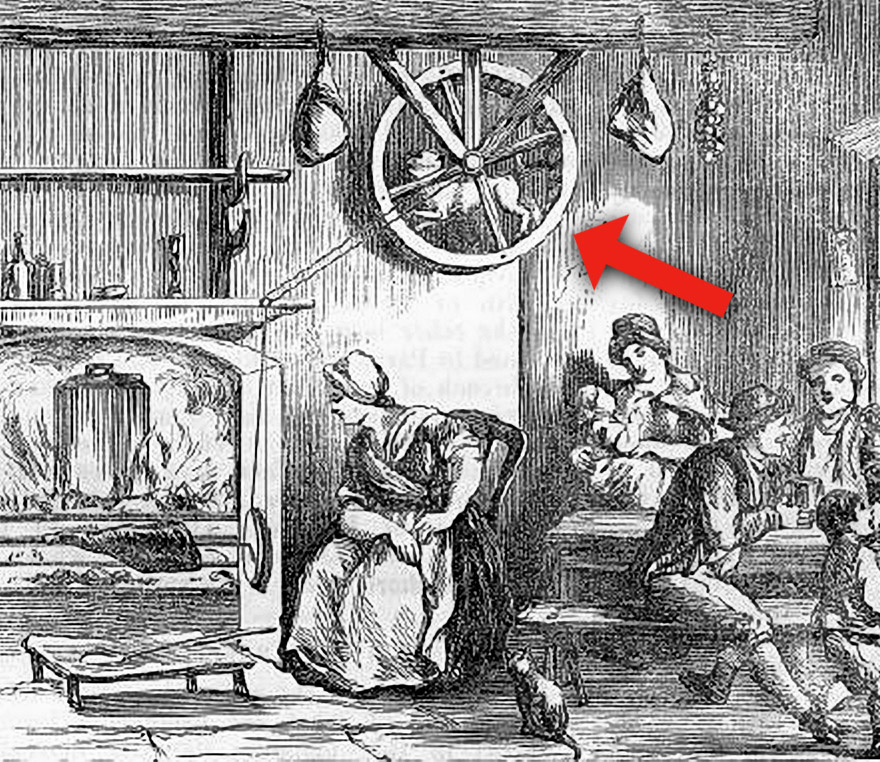
“… little patient creatures, long-bodied and crook-legged, whose lives were spent in the exquisite tantalization of helping to cook the meat, whose appetizing odors of roasting they sniffed for hours without any realization of tasting at the end of their labors.
“Certain dogs in kitchen service excellent. When meat is to be roasted they go in a wheel, where, turning about with the weight of their bodies they so diligently look to their business that no drudge or scullion can do the feat more cunningly.”
A dog was trained by being put in the wheel. A burning coal was placed with him. If he stopped, his legs were burned. That was all. He soon learned his lesson. It was hard work, for often the great piece of beef was twice the weight of the dog, and took at least three hours’ roasting.
Q: Any suggestions or resources we could use.
A: See our References and Links page, and also:
- Sarah Kemble Knight, The Journal of Madam Knight, originally published by Theodore Dwight (New York, 1825)
- Alice Morse Earle, Stage-Coach & Tavern Days (1900)
Q: Describe the job of the taverner in detail.
A: The taverner’s first job was to persuade the court or other authority to grant a license to operate. Then the newly licensed taverner developed his or her home or other building into the space required for the tavern and stables. Next, there was the needc to stock the establishment with food, drink, bedding, fire wood, hay, and water for the horses. The taverner welcomed the guests, took their orders, and prepared the food and drink. The taverner or one of the hands who helped to keep the business running smoothly (usually the spouse or an elder child) had to keep accounts of the expenses incurred and be sure the taverner was promptly paid.
If the tavern was located out in the country, there was probably a farm where the necessary produce was grown and where cattle were kept for milk, cheese, and meat. If the location was in an apple-growing climate, an orchard located on the property usually provided the produce for hard cider served to guests. Alternatively, if these accommodations did not exist, the taverner would have to buy these provisions.
Obviously one person did not do this alone – family, employees, partners, and maybe slaves helped.
Q: Do you need to be an apprentice for your job? If so, for how long, and what process do you go through to become the master of your craft?
A: There were no formal apprenticeship or guild requirements. People pretty much learned by observing and doing.
Q: If you need tools, what are they (the tools of your trade)?
A: A tavern- or innkeeper provided a “home away from home” for travelers, so all of the household tools for cooking, cleaning, lighting, serving meals and drinks were used, but on a larger scale than in a typical home.
Q: What “pictures” were used for the sign out side your trade shop?
A: The simplest sign of a tavern was a sheaf of wheat hung over the doorway. Alice Morse Earle in Stage Coach and Tavern Days (see our references and links page) describes some of them:
Before named streets with numbered houses came into existence, and when few persons could read, painted and carved sign-boards and figures were more useful than they are today; and not only innkeepers, but men of all trades and callings sought for signs that either for quaintness, appropriateness, or costliness would attract the eyes of customers and visitors, and fix in their memory the exact locality of the advertiser. Signs were painted and carved in wood; they were carved in stone; modelled in terra-cotta and plaster; painted on tiles; wrought of various metals; and even were made of animal’ heads stuffed.
The shops in Boston were known by sign-boards. In 1761 Daniel Parker, goldsmith, was at the Golden Ball, William Whitmore, grocer, at the Seven Stars, Susannah Foster was “next the Great Cross,” and John Loring, chemist, at the Great Trees. One hatter had a “Hatt & Beaver,” another a “Hatt & Helmit”; butter was sold at the “Blue Glove” and “Brazen Head”; dry-goods at the “Sign of the Stays” and at the “Wheat Sheaf”; rum at the “Golden Keys”; pewter ware at the “Crown and Beehive”; knives at the “Sign of the Crown and Razor.” John Crosby, for many years a noted lemon trader, had as a sign a basket of lemons. In front of a nautical instrument store on the corner of State and Broad streets, Boston, still stands a quaint wooden figure of an ancient naval officer resplendent in his blue coat, cocked hat, short breeches, stockings, and buckles, holding in his hand a quadrant. The old fellow has stood in this place, continually taking observations of the sun, for upwards of one hundred years. It will be seen that these signs were often incongruous and non-significant, both as to their relation to the business they indicated, and in the association of objects which they depicted.
Many of the apparently meaningless names on tavern signs come through the familiar corruptions of generations of use, through alterations both by the dialect of speakers and by the successive mistakes of ignorant sign-painters. Thus “The Bag o’ Nails,” a favorite sign, was originally “The Bacchanalians.” The familiar “Cat and Wheel” was the “Catherine Wheel,” and still earlier “St. Catherine’s Wheel,” in allusion to the saint and her martyrdom. The “Goat and Compass” was the motto “God encompasseth us.” “The Pig and Carrot” was the “Pique et Carreau” (the spade and diamond in playing cards).
Older kids might enjoy The Tavern at the Ferry written and illustrated by Edwin Tunis, published by Thomas Y. Crowell Co. (New York, 1973). This entertaining book describes the development of settlements, taverns, and ferry crossings along the Pennsylvania and New Jersey shores of the Delaware River and the events leading up to Washington’s crossing of this river in 1776 on the way to the victorious battle at Trenton. The chapter headings illustrate typical tavern signs and many sketches throughout show life in the colonial era.

 Flagon and Trencher: Descendants of Colonial Tavernkeepers